Publix: community helper or hazard?
It was a Wednesday after a day of patient care. I had just picked my children up from school. All I wanted was to get my groceries and avoid any more outside human contact, so I could divert what little energy I had left for the day into my children. Out of self-preservation, I was intentionally self-hired at the self-checkout line at Publix when a quiet, visibly uncomfortable teenager behind the register asked: would I like to donate to help protect Florida’s waterways?
It was one of those moments that felt small on the surface and enormous underneath. You could tell this kid did not create the message. He was just trying to get through a shift, repeating what he had been told to say, holding a little promotional visual that corporate had distributed, likely hoping I would either donate quickly or politely decline so the tension would pass. And for a second, I was torn. Part of me wanted to spare this teen from the discomfort, smile, hand over a dollar, and let him feel a combination of relief and accomplishment… while the other part of me could not ignore the absurdity of the moment.
My ten-year-old watched me struggle internally. Grappling with the question:
“How does Publix ask customers to donate to protect Florida’s waterways while the company has spent years being criticized for helping block local efforts to reduce plastic and foam waste in the first place?”
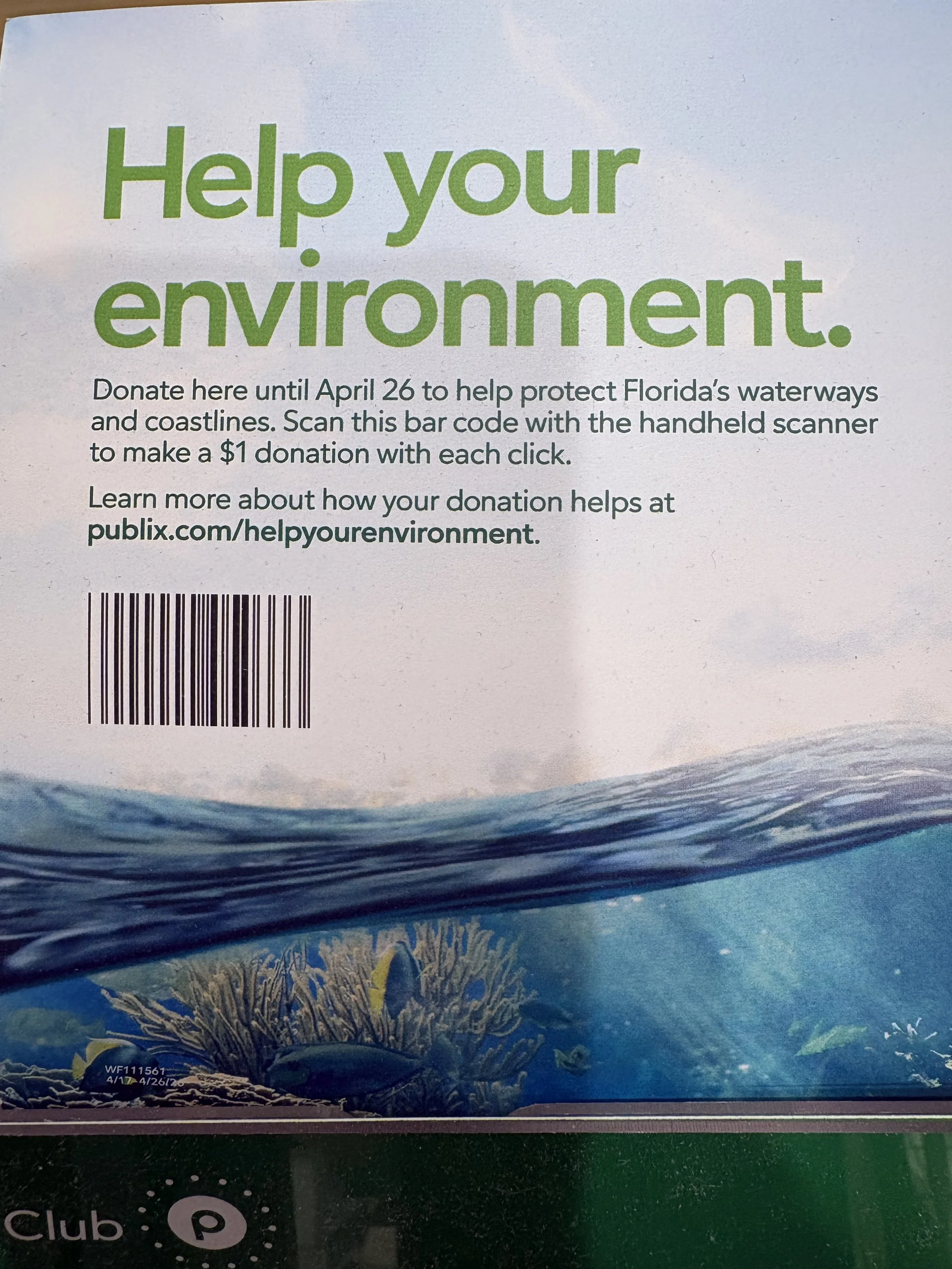
The visual representation of Publix’s assumption that their patrons are mindless, unintelligent consumers who lack discernment or community awareness.
To bring you up to speed, it’s important to know that:
Publix was part of the business push behind Florida’s override of local foam rules. Florida’s plastic-bag preemption was passed by the Legislature in 2008, freezing cities and counties out of the fight unless lawmakers later acted on Dept. of Environmental Protection recommendations; they still largely have not. Into that vacuum stepped the Florida Retail Federation, a trade group representing major retailers including Publix, which became one of the clearest forces defending and enforcing that state shield. They then turned that legal freeze into a weapon against local communities.
When towns tried to protect their own communities anyway, they got hit: Surfside backed down after legal threats, Coral Gables was sued and lost, and Gainesville repealed its ban after the courts made clear local ordinances were vulnerable to attack. The message to local leaders is clear: even if your residents want less plastic and foam in their neighborhoods and waterways, you may not get to decide.
Tampa Bay Times reported that Publix accepted a plastic bag ban in South Carolina while being “a driving force” against similar local bans in Florida. This is called a “double standard,” and it eliminates the argument that plastic restrictions are somehow unworkable for a company of Publix’s size. When this occurred in 2019, CBS reported that Publix was part of the Florida Retail Federation, and described this trade group as supporting legislation that blocks local communities from banning items like plastic bags. In 2021 , Greenpeace’s supermarket plastics ranking made the same connection and criticized Publix for supporting “pro-plastics lobby groups” like the Florida Retail Federation.
What this shows is that the question was not whether Publix could function under tighter rules. It could and it did. The issue is instead about who gets to make the rules. In South Carolina, Publix accommodated a local ban, because it had to. In Florida, it was associated with a trade group fighting to keep that kind of local choice off the table. So the contradiction is not just “Publix did one thing here and another thing there.” The deeper discrepancy is that Publix appears willing to comply where it must, while helping resist the spread of those same restrictions where it still has the political cushion to do so. That says a great deal about where the company stands when environmental limits are optional versus when they are mandatory.
Greenpeace also faulted Publix for lacking transparency about its plastic footprint and for not showing stronger time-bound commitments to reduce single-use plastic.

Actual picture of internal struggle when faced with a simple question at the Publix check out counter.
These were just a few of the recent conflicts flashing through my mind. So instead of donating, I said, “Thank you for asking, and I do hope our waterways are healed, but I’d like to take this up with corporate on a matter of principle. Can you help me find someone who can share their contact?”
Needless to say, my ten year old was mortified, and I later explained to her that while her feelings matter deeply to me, I would rather risk her temporary discomfort than miss an opportunity to try to protect the environment for her, for her siblings, and for whatever future children may come after them. She understood. She agreed. She said she would probably do the same.
A few days later, this exchange has stayed with me because it exposed something bigger than one awkward moment in a checkout line. It showed how neatly corporations can place young workers between themselves and public accountability. A teenager at a register becomes the soft human buffer between a massive company and the customer’s real frustration. The customer is left choosing between making an innocent kid uncomfortable or quietly participating in a message that feels manipulative.
The bottom line is that this campaign rings hollow from inception to delivery.
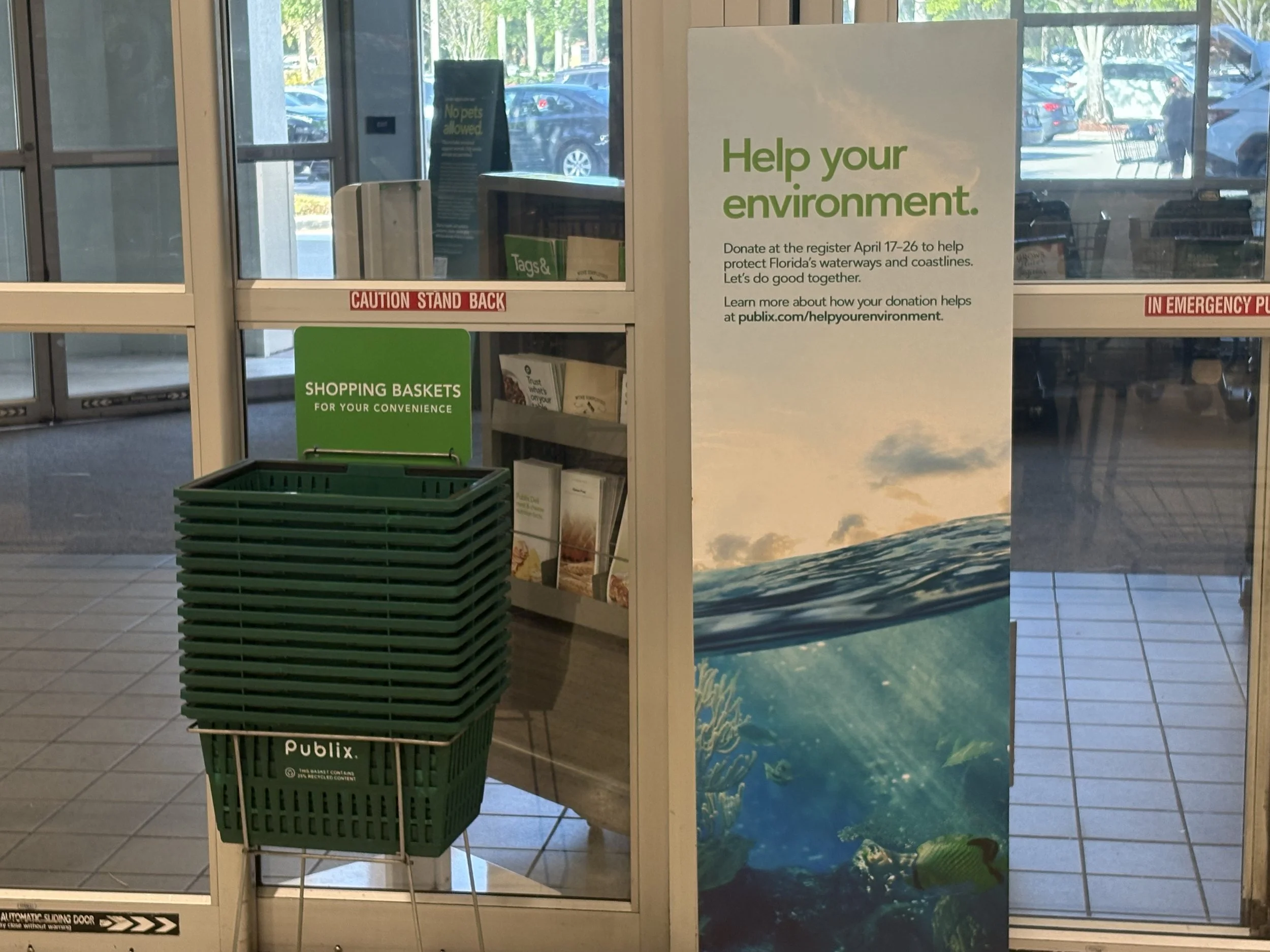
A hollow campaign which brings to the surface the deeper deception of Publix’s false public image.
Florida law still prevents local governments from regulating disposable plastic bags, and state law also preempts local regulation of polystyrene products. That means communities that want to respond to their own litter, shoreline waste, and environmental damage have had their hands tied by the state. When Publix asks customers to donate to protect waterways while having been associated with the political apparatus behind those barriers, it does not feel like stewardship. It feels like image management. It feels like a disgusting lie marinating in the flavor of this never-ending season of corporate greed.
The problem that runs deeper than our beautiful Florida springs and shorelines is TRUST.
Floridians care deeply about their waterways, and they know when they are being played. There is something deeply insulting about a corporation asking families for one more dollar at the register to “protect” the environment while continuing to benefit from waste-heavy systems and trade-group politics that have helped slow meaningful local action. Customers are surrounded by plastic bags, packaging, containers, and foam at every turn, then asked to help fund the cleanup of the downstream damage. The burden is pushed onto the public, morally and financially, while the corporation gets the reputational benefit of appearing concerned. That contradiction says everything - not about the campaign, but about how little respect Publix has for the intelligence of their own customers.
If Publix truly wants to protect Florida’s waterways, then Publix should start by changing Publix. It should publicly support the right of Florida communities to reduce plastic and foam waste locally. It should stop backing, directly or indirectly, trade-group efforts that fight those protections. It should phase out unnecessary single-use plastic and foam more aggressively, publish measurable reduction goals, disclose its plastic footprint, invest in reusable and refillable systems, and fund restoration from corporate profits instead of asking customers to carry the moral burden at checkout. It should BE the change before asking for our support.
Many of us who have been paying attention lost trust in Publix a long time ago. Trust will not be rebuilt through signage and donation prompts. It will be rebuilt through visible, measurable action - action that proves the company is willing to reduce its own role in the problem before asking the public to help pay for the solution. And maybe that is part of what I want my children to understand most. Caring for the earth is not just about handing over a dollar when a corporation asks.
It is also about recognizing contradiction, speaking respectfully, asking better questions, and refusing to confuse marketing with stewardship.
So as your faithful holistic health coach, my on-brand public health message that I will always reiterate is consistent in this situation, too: Do not consume without discernment.
I encourage you to flood the inbox at https://www.publix.com/contact with the below message:
Letter to Publix Corporate
To Publix Corporate,

Your campaign asking customers to donate to protect Florida’s waterways is insulting to the intelligence of the communities you serve.

Publix has been tied to efforts that helped block local plastic and foam restrictions in Florida, while continuing to profit from plastic-heavy systems in its own stores. So asking families for one more dollar at checkout to “protect” waterways does not read as stewardship. It reads as hypocrisy.

If Publix wants trust, it should earn it by reducing plastic at the source, stopping support for obstructionist lobbying, and funding restoration from corporate profits — not customer guilt.

Be the change before you ask for our support.

Sincerely,
-Your Name, City, State -